
Dorothy Dunnett Society Weekend 2026
Friday 24 to Sunday 26 April
Glynhill Hotel & Spa, Renfrew
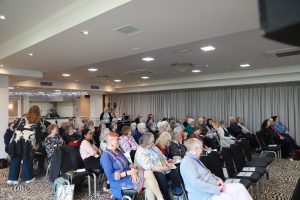
Our DDS weekend was held in Renfrew this year and enjoyed by all. We held to our usual format with a Welcome Meal on Friday, followed by lectures, AGM and Gala Dinner on Saturday. Our Sunday Trip was to the Burrell Collection where we explored the eclectic collection of wonderful artefacts.
Saturday Lecture Programme
Dr Sarah Cockram
Handling Menagerie Animals
Her book, Interspecies Interactions: Animals and Humans between the Middle Ages and Modernity was also available at the weekend.

Dorothy Dunnett’s writings show insight into the value of unusual and impressive animals to the Renaissance elite, and the varied roles that might be played by those who transported, trained, and tended to these creatures. This paper will introduce handlers and the logistics of animal keeping at court, considering the duties of personnel such as the mahout, lion tamer, cheetah trainer, and custodian of monkeys, ostriches, gazelle, rhino, or giraffe, as well as the experience of non-experts who found themselves responsible for looking after high-status beasts. The paper will explore how understanding across species lay at the heart of skilled care of such animals (whose needs may be difficult to know or to meet), and will consider what could happen when things went wrong, when animals ailed, misbehaved, or went on the attack. The paper investigates the lives of the animals themselves, in the menagerie or villa gardens, taking part in spectacles, on the hunt, and sometimes inside the palace, as favoured companions to the ruling family.
Sarah Cockram is a historian of the late medieval and early modern periods, particularly of Renaissance Italy, specialising in court studies, gender history, and historical animal studies. Sarah is a Lecturer in Mediaeval History at the University of Glasgow and an Honorary Fellow in the School of History, Classics and Archaeology at the University of Edinburgh. Sarah’s next book will examine Courtly Creatures and her publications include attention to the expertise of handlers of menagerie animals, and to the lived experience of animals in collections such as that of the Medici family. Sarah has a forthcoming publication on big cats as companion animals in portraits (investigating portrayals of rulers living closely alongside lions and leopards). In the book Interspecies Interactions: Animals and Humans between the Middle Ages and Modernity, Sarah focusses on relationships with beloved dogs and cats, reflecting her interest in questions of human and animal health, in sensory and emotional experience, and in the history of pet-keeping.
Dr John Drakakis
The Merchant of Venice and the problem of anti-Semitism
“The Merchant of Venice and the problem of anti-Semitism” aims to challenge the abiding myth of Shakespeare’s ‘timelessness’. Shylock is an English name, and ‘the Jew’ is a householder. His daughter Jessica’s elopement is one of the very few sanctioned elopements in the Shakespeare canon, and the contrast with Portia is direct. Is The Merchant of Venice an ‘anti-Semitic play’, as Harold Bloom would have it, or does it interrogate the basis of anti-Semitism?

John is Emeritus Professor of English Studies at the university of Stirling. He has published widely in the area of Shakespeare Studies and is the editor of Alternative Shakespeares, a series that had a fundamental effect on the academic study of Shakespeare in Britain, alongside Dollimore and Sinfield’s Political Shakespeare. He is also editor of The Merchant of Venice for the Arden 3 series and Q1 Richard III. John was a founding trustee of the British Shakespeare Association and was chair of its Fellowships sub-committee. In 2019 he was awarded an Honorary Fellowship of the British Shakespeare Association. He is an elected fellow of the English Association, a fellow of the Academia Europoeia, and he holds an honorary D.Litt. from the University of Clermont-Auvergne. He is the general editor of the Routledge New Critical Idiom series, to which he has contributed the volume on Tragedy. He has recently published a book entitled Shakespeare’s Resources which has just appeared in paperback, and has just completed the manuscript of a book entitled Oral Shakespeare. In addition he has contributed articles and reviews to a number of learned journals, and to a number of published collections of essays on Shakespearean and other topics.
Dr Sharon Michalove
Code Switching in the Fifteenth Century
“Code switching” is a term coined in the 1950s by William Freeman Twaddell, a professor at Brown University. At the beginning scholars thought this was an attribute of substandard language usage and it was labeled as a racist idea. However, now code switching is seen as a product of bilingual and multilingual speakers. It has connotations from both linguistic and sociological perspectives. This talk will explain the concept of code switching as it relates to the House of Niccolò. I will begin and end the talk with examples from the present time and how they illuminate the conjunctions between the past and the present.

Nicholas de Fleury is a perfect exemplar both linguistically and sociologically. His social standing allows him to be a chameleon who can fit into a multitude of societies. His gift for accumulating knowledge and marketable information means that he has value to political and mercantile leaders, and his humble beginnings in the dye yard in Bruges mean that he can also mix well with servants and artisans who sometimes have more valuable information than more exalted classes.
The multiplicity of characters, real and fictional, comprises an amalgam from across Europe. Bruges was a melting pot of dialects at a time when there were no standardised languages, including Picard French, Flemish, various versions of Italian, Portuguese, Spanish, English, Scots, and various Hanseatic trading languages, as well as Latin. The idea of being able to switch from one language to another within the same conversation or to easily slip into a new culture is at the heart of the series.
As we move through much of the known world with Nicholas and his companions, we can see how communication, dress, adopting different identities, and transitioning from couriers to soldiers, sailors to courtiers, merchants to diplomats to pilgrims, are social and linguistic forms of code switching. The transmutation of identities is a central theme and I hope to illuminate how Dorothy Dunnett uses these various means to give a deeper picture of negotiating society in a period of struggle between continuity and change as late medieval ideas clash with a budding modernity.
Sharon Michalove grew up in suburban Chicago. She received four degrees from the University of Illinois because she didn’t have the gumption to go anywhere else, and spent most of her career at the university, eventually earning a PhD, working in departmental administration, publishing and libraries. Her specialties are 15th-16th century European history, polar exploration and food history. She may be one of the few people in America to never live outside her home state. In graduate school, she met and married the love of her life. They shared a love of music, theater, travel and cats. He died in 2013. Sharon also loves hockey, reading, cooking, writing, and various less elevated activities like eating cookies and sampling gins and single malts. After spending most of her life in a medium-sized university town she moved back to Chicago in 2017 so she could go to more Blackhawks games and spend quality time at Eataly. She hopes to accomplish a lifetime goal by publishing her first novel this year. Unfortunately her other lifetime goal, to be English, is likely to remain unfulfilled.” Source: www.bookbub.com
More News


